Company News

Biotle’s Next-Generation Long-Acting FcRn Inhibitor BTL-203 Receives Clinical Trial Approval from China CDE

HANGZHOU, China — May 22, 2026 — Biotle today announced that it has received a Clinical Trial Notice from the Center for Drug Evaluation (CDE) of China’s National Medical Products Administration (NMPA) for the Investigational New Drug (IND) application of BTL-203, the company’s bispecific FcRn inhibitor. BTL-203 is being developed for the treatment of multiple autoimmune diseases.

“We are very pleased that the IND application for BTL-203 has been approved in China. This is an important milestone for Biotle in autoimmune diseases and marks the entry of our second innovative program into clinical development, reflecting the company’s growing capabilities in bispecific and trispecific antibody therapeutics. We will accelerate the clinical development of BTL-203 and strive to bring a more convenient treatment option to patients with autoimmune diseases as soon as possible.”

— Dr. Jiansong Yang, Founder and CEO of Biotle

About BTL-203

BTL-203 is a bispecific antibody for the treatment of autoimmune diseases. It works by blocking the interaction between FcRn and IgG with high affinity, thereby inhibiting FcRn-mediated IgG recycling and accelerating the lysosomal degradation of pathogenic IgG.

BTL-203 also has the potential for a longer half-life than currently available therapies in the same class. Through the combined pharmacologic effects of efficient IgG clearance and prolonged systemic exposure, the program is designed to support once-every-four-weeks subcutaneous dosing, with the goal of maintaining consistent efficacy, extending dosing intervals, and improving patient convenience.

About Biotle

Biotle is an innovative biotechnology company focused on the clinical translation of next-generation antibody therapeutics. The company has built an experienced end-to-end team spanning early research through clinical development, with core members averaging more than 10 years of industry experience.

Biotle’s proprietary TriME trispecific antibody platform offers modular assembly, high stability, low mispairing, and strong expression, enabling rapid advancement of multiple bispecific and trispecific antibody candidates.

The company’s current core programs include:

  • BTL-101: a BCMA × GPRC5D × CD3 trispecific antibody, approved for IND and currently in Phase I/II clinical development;
  • BTL-203: a long-acting FcRn inhibitor for autoimmune diseases, now approved for clinical development in China; and
  • BTL-306: a first-in-class bispecific antibody for autoimmune and metabolic diseases, which has completed PCC studies.

Guided by the principle of “rooted in fundamentals, driven by innovation,” Biotle is committed to becoming a leader in the clinical translation of next-generation antibody medicines and to delivering safer, more effective, and more accessible treatment options to patients worldwide.

Business Development: contact us to explore partnering opportunities.

BTL-101 Selected for Oral Presentation at EHA2026 Congress

HANGZHOU, China — May 6, 2026 — Biotle today announced that BTL-101 has been selected for an oral presentation at the EHA2026 Congress. Dr. Jiansong Yang, Chief Executive Officer of Biotle, will present preclinical data for BTL-101 during the Oral Session “s411 T cell redirected therapy in multiple myeloma” on June 11, 2026, from 16:45 to 18:00 CEST in Victoria Hall, Stockholm, Sweden.

The presentation, titled S189 BTL-101, A FULLY HUMAN TRISPECIFIC BCMA×GPRC5D×CD3 T-CELL ENGAGER FOR THE TREATMENT OF MULTIPLE MYELOMA, was selected as part of the EHA2026 scientific program, highlighting the growing interest in next-generation T-cell redirected therapies for multiple myeloma.

BTL-101 is Biotle’s fully human trispecific T-cell engager targeting BCMA, GPRC5D, and CD3, designed to address tumor heterogeneity and antigen escape in multiple myeloma while supporting a differentiated safety and manufacturability profile.

Biotle looks forward to sharing BTL-101 preclinical findings with the hematology community at EHA2026 and to continuing advancement of the program in relapsed/refractory multiple myeloma.

Business Development: contact us to explore partnering opportunities.

Biotle’s BTL-101 (BCMA × GPRC5D × CD3 Trispecific Antibody) Receives IND Approval in China

HANGZHOU, China — April 16, 2026 — Biotle today announced that the National Medical Products Administration (NMPA) of China has approved an Investigational New Drug (IND) application for BTL-101, the company’s internally developed next-generation trispecific T-cell engager targeting BCMA × GPRC5D × CD3ε. BTL-101 has been cleared to enter a Phase I/II clinical trial for the treatment of relapsed/refractory multiple myeloma (RRMM).

About BTL-101

BTL-101 is a next-generation trispecific T-cell engager directed against BCMA, GPRC5D, and CD3ε, developed using Biotle’s proprietary TriME fully human anti-CD3ε antibody platform. The program is designed to combine potent anti-myeloma activity with an optimized safety and manufacturability profile.

  • Optimized CD3 affinity: Designed for fast-on / fast-off binding kinetics to support efficient tumor-cell killing while reducing the risk of T-cell exhaustion and cytokine release syndrome (CRS).
  • Natural IgG-like architecture with KiH and common light-chain design: Significantly reduces heavy/light-chain mispairing while enabling high yield (>6 g/L), high purity, and good stability.
  • Reduced FcγR binding: Minimizes non-specific immune activation and supports improved safety.
  • Activity under challenging disease conditions: In vitro, BTL-101 maintained potent cytotoxic activity in BCMA-low–expressing cells (MM.1S) and in the presence of soluble BCMA at concentrations up to 500 ng/mL, outperforming existing comparator molecules.

BTL-101 has the potential to become a best-in-class therapy in multiple myeloma. It may also offer expansion potential into autoimmune diseases, including systemic lupus erythematosus and immune-mediated kidney diseases, where short-course deep depletion of pathogenic plasma cells could enable immune reset and durable drug-free remission.

Competitive Landscape

In multiple myeloma, approved BCMA/CD3 bispecific antibodies such as teclistamab and GPRC5D/CD3 bispecific antibodies such as talquetamab have demonstrated meaningful clinical activity, but important challenges remain, including BCMA resistance, extramedullary disease, and cytokine release syndrome. As one of the few trispecific T-cell engagers globally to reach the clinical stage, BTL-101 is designed to address these limitations by simultaneously targeting both BCMA and GPRC5D, broadening tumor-antigen coverage, reducing the risk of antigen escape, and potentially improving efficacy in patients previously treated with BCMA-directed therapies.

With its differentiated molecular design and favorable CMC profile, BTL-101 is positioned to offer meaningful advantages in efficacy, safety, and dosing convenience, including the potential for once-every-four-weeks subcutaneous administration.

About Biotle

Founded in February 2025, Biotle is an innovative biotechnology company focused on the clinical translation of next-generation antibody therapeutics. The company has built an experienced end-to-end team spanning early research through clinical development, with core members averaging more than 10 years of industry experience.

Biotle’s proprietary TriME trispecific antibody platform offers modular assembly, high stability, low mispairing, and strong expression, enabling rapid advancement of both bispecific and trispecific antibody candidates. The company’s current core programs include BTL-101, which has now received IND clearance and entered Phase I/II clinical development; BTL-203, a long-acting FcRn inhibitor for autoimmune disease, for which an IND has been submitted; and BTL-306, a first-in-class bispecific antibody for autoimmune/metabolic disease, which has completed PCC studies.

Guided by the principle of “rooted in fundamentals, driven by innovation,” Biotle is committed to becoming a leader in the clinical translation of next-generation antibody medicines and to delivering safer, more effective, and more accessible treatment options to patients worldwide.

Business Development: contact us to explore partnering opportunities.

Biotle Announces Preclinical PK/PD Results for FcRn Inhibitor BTL-203; Modeling Supports Once-Every-Four-Weeks Subcutaneous Dosing in Humans

HANGZHOU, China — September 8, 2025 — Biotle today announced positive preclinical pharmacokinetic/pharmacodynamic (PK/PD) results for BTL-203, the company’s half-life–extended neonatal Fc receptor (FcRn) inhibitor. In cynomolgus monkeys, BTL-203 produced deep and sustained reductions in total IgG after single-dose intravenous (IV) or subcutaneous (SC) administration. Using a semi-mechanistic FcRn–IgG turnover model calibrated to these data, simulations project that subcutaneous dosing every four weeks (Q4W) could maintain clinically meaningful IgG suppression in humans.

“These encouraging data, together with our translational modeling, suggest BTL-203 could offer once‑every‑four‑weeks subcutaneous dosing—meaningfully less frequent than today’s approved FcRn regimens, which are administered in weekly cycles. We believe this convenience, alongside potent IgG lowering, positions BTL-203 as a potential best‑in‑class therapy, subject to confirmation in clinical studies.”

— Dr. Jiansong Yang, CEO of Biotle

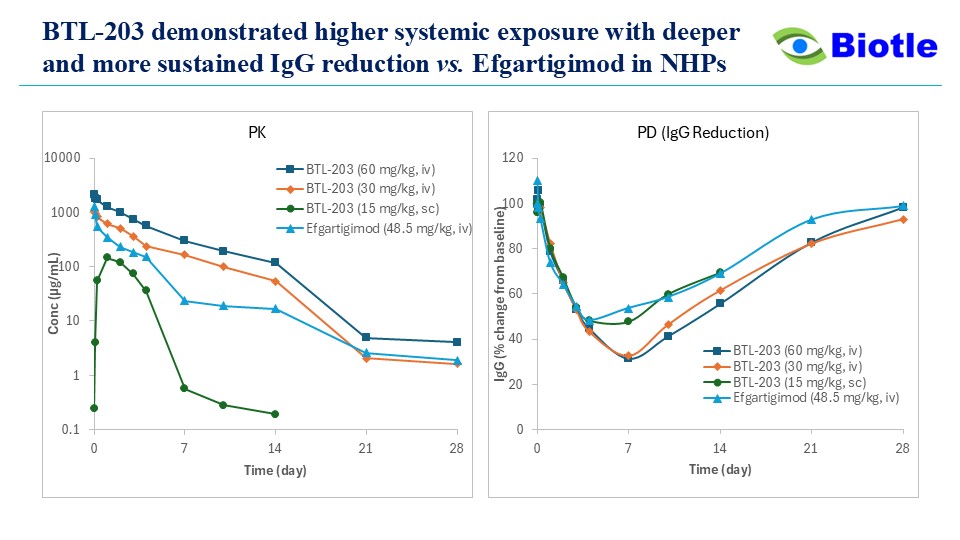
BTL-203 PKPD in cynomolgus monkeys

Nonclinical Highlights

  • Robust IgG lowering vs comparator: Single IV doses of BTL-203 (60 or 30 mg/kg) achieved higher systemic exposure and deeper, more sustained total‑IgG reductions than efgartigimod IV (48.5 mg/kg) in the study; nadir decreases were ~67–69% with recovery by ~4 weeks.
  • SC administration: BTL-203 15 mg/kg SC produced total‑IgG reduction comparable to efgartigimod 48.5 mg/kg IV.
  • Translational projection: Population PK/PD modeling suggests Q4W SC dosing in humans could sustain IgG lowering within a target therapeutic window; this will be tested prospectively in clinical trials.
  • Safety & tolerability: BTL-203 was well-tolerated in cynomolgus monkeys. At 15 mg/kg SC, albumin decreases and LDL‑C changes were minimal and reversible.

Potential differentiation. Approved FcRn therapies today are delivered in weekly (SC) or biweekly (IV) treatment cycles. If confirmed clinically, a Q4W SC maintenance regimen would represent a less frequent dosing schedule for an FcRn inhibitor.

About BTL-203

BTL-203 is an FcRn inhibitor engineered for extended exposure and infrequent subcutaneous dosing. By blocking FcRn, BTL-203 accelerates IgG catabolism—a validated mechanism across multiple IgG‑mediated diseases. Biotle is advancing BTL-203 toward clinical development (planned IND submission in Q2 2026) and is engaging potential partners to accelerate global development and commercialization.

Business Development: contact us to explore partnering opportunities.

Biotle CEO Dr. Yang to attend Bio Europe 2025 for partnering on BTL-101 and BTL-203

Biotle today announced that its Chief Executive Officer, Dr. Jiansong Yang, will attend Bio Europe 2025, taking place November 3–5 in Vienna, Austria, to pursue partnering opportunities for BTL-101 and BTL-203. Dr. Yang will provide updated status and target disclosure at the conference.

BTL-101 (targets undisclosed). BTL-101 is a pioneering trispecific T-cell engager built on Biotle’s TriME® platform, designed to address tumor heterogeneity in relapsed or refractory multiple myeloma and select autoimmune indications. Highlights include:

  • Simultaneous targeting of CD3ε and two tumor-associated antigens (TAAs) to overcome antigen escape and resistance.
  • Fully human, high-affinity binding domains with low CD3ε affinity to reduce cytokine-release risk.
  • Fc LALAPG silencing to prevent unwanted T-cell clearance.
  • High subcutaneous bioavailability (~100% in mice) and stable high-concentration formulation (>100 mg/mL).
  • Projected once-every-4-weeks subcutaneous dosing; strong CMC profile (7–8 g/L titers; 4-week stability at 40 °C).
  • Demonstrated potent, precise tumor-cell killing with minimal off-target effects in preclinical models.

BTL-203 (an FcRn inhibitor with extended half-life). A next-generation bispecific antibody designed for deep, durable effect with convenient once-every-4-weeks subcutaneous dosing for autoimmune diseases. Advantages include:

  • Extended exposure and stabilized effect.
  • Deep & durable effect linked to superior outcomes in autoimmune diseases.
  • Improved convenience and compliance vs. weekly or biweekly dosing by competitors.
  • Supports broad indication expansion in chronic autoimmune diseases.
May 1, 2025
Biotle to move into Tigermed's life‑science campus in Hangzhou in Q1, 2026

Tigermed’s new headquarter and life‑science campus in Binjiang, Hangzhou has completed construction and passed final acceptance. Biotle will be the first biotech to move into Tigermed’s on‑site incubator. Our new office is planned to be ready for move‑in during Q1 2026, supporting our continued growth in innovative therapeutics.

We look forward to welcoming partners and stakeholders to our new headquarter as we pursue our mission of transforming cancer care worldwide.

Biotle's new office in Hangzhou
Tigermed’s new headquarter and life‑science campus in Binjiang, Hangzhou